
Bernina 125 Jubilae
Pride and joy
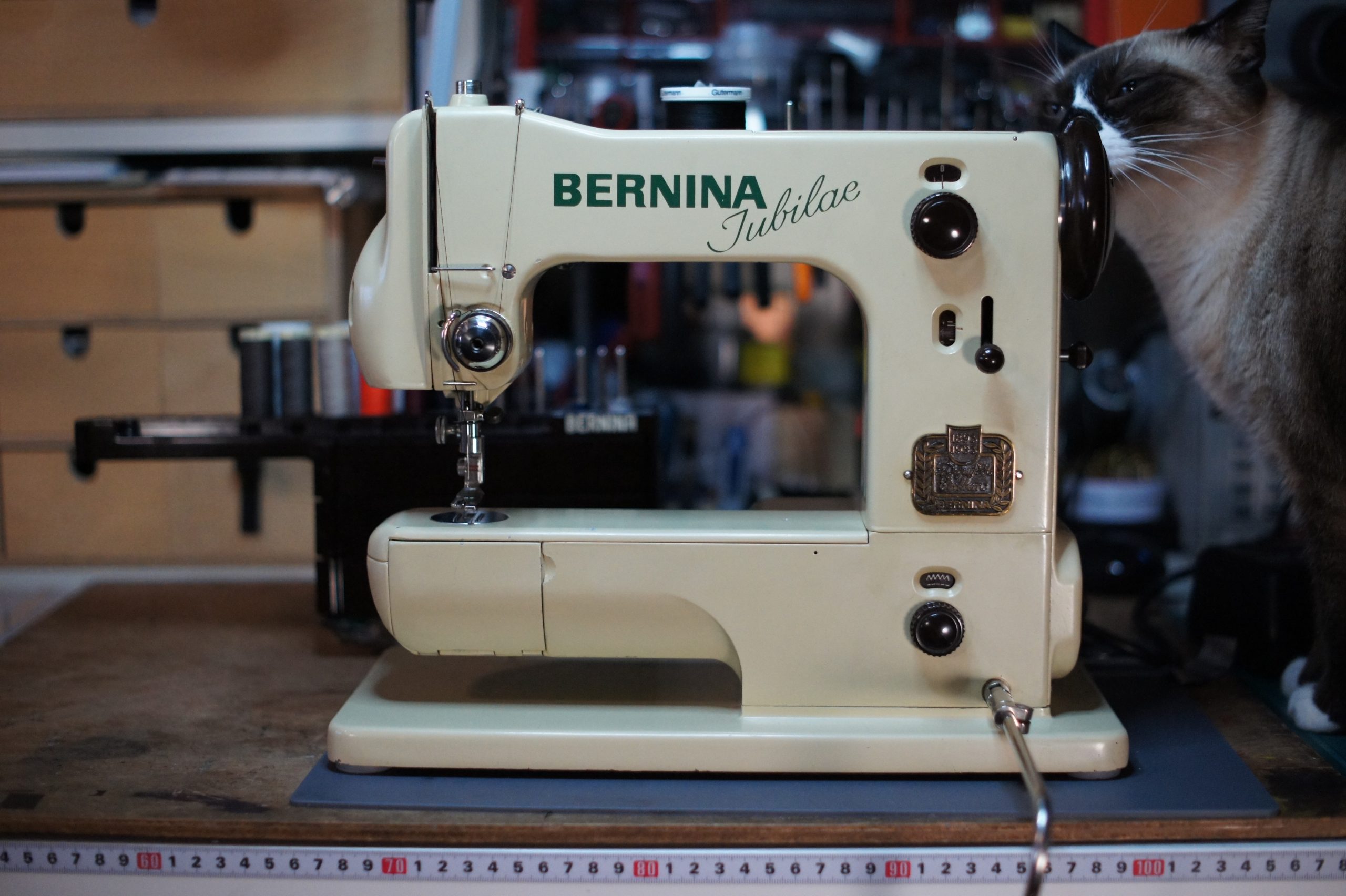
Bernina began in Steckborn, Switzerland, in 1932, building on Karl Friedrich Gegauf’s 1893 invention of the hemstitch sewing machine. The company entered the household market that year with the Model 105, and by 1938 the Model 117 introduced zigzag stitching to the lineup. The Bernina 125, the machine pictured here, followed as a refinement of that idea and became something of a milestone in its own right.
First issued in 1943, the 125 is widely credited as the first free arm automatic zigzag machine available anywhere, a genuinely significant claim for a machine this compact. This particular example is a Jubilae edition, produced in 1953 to mark the sixtieth anniversary of Bernina’s founding, hence the proud “Jubilae 1893-1953” badge bolted tot he front. No pressure, sixtieth birthday machine, just casually inventing a whole new stitch category.
Mechanically it is all metal, densely packed into a portable body, and controlled via a knee lever rather than a foot pedal, a control method Bernina favored on many of these early machines. The speed control is achieved via two stacks of sizzling carbon discs, mounted above the motor, which still provide admirably fine control over stitch velocity.
It sews straight, zigzag, and reverse stitching, and this particular model can also accept a double needle, a nice trick for a machine from the era of ration books and rebuilding economies. Reverse, incidentally, isn’t a separate lever. It’s tucked into the stitch length control, an efficient bit of design that avoids adding yet another dial. In fact, the entire control layout, including the drop feed knob, would remain very similar in the following decades across Bernina’s mechanical ranges, all the way up to the 1000 series and well into the 21st century. A notable difference is the needle position control: while present but somewhat hidden at the back in this machine, it would later be combined with the width control at the front, a logical coupling.
This little devil also includes one of Bernina’s most praised and long lasting features, and one of the secrets of its success: a double-belt pulley system that converts the motor speed to torque, making this small compact machine much more powerful than its size might suggest.
But the real innovation here isn’t any single dial or knob. It’s the tiny free arm itself, combined with genuine automatic zigzag in a portable domestic machine, at a time when many competitors were still offering straight stitch only or awkward attachments to achieve a zigzag effect, in flat bed bulky bodies. Bernina folded the whole mechanism into a small, self contained unit that a home sewist could carry to a class or a relative’s house, no small feat of engineering for 1943. And the free arm still remains one of the slimmest you can find on any machine of any era.
Owners today mostly agree the 125 has aged well, in the stubborn way that old mechanical machines tend to. One long time owner describes it as a gutsy little machine that replaced her grandmother’s earlier model without complaint, and several collectors online report units still running after a belt change or a proper oiling, nothing more dramatic required. A recurring minor gripe involves the bobbin door, which can pop open mid seam if its spring has weakened with age, but this reads more as a footnote than a flaw, the sort of thing any seventy year old machine earns the right to have — and a very easy fix.
Compared to contemporaries like Singer’s Featherweight, often mentioned in the same breath by collectors, reviewers note the two machines are roughly similar in size and were sold around the same period. Though the 125 is no feather when it comes to weight (the Singer’s aluminium body had no competition there), it pulls ahead on stitch versatility thanks to its zigzag capability, while the Featherweight sticks to straight stitch simplicity. Neither machine is fast by modern standards, and neither cares. They were built to last, not to hurry, and the Bernina 125 has generally kept its part of that bargain.
This particular unit runs on 120 Volts, denoting American market origins. It is known to have been taken to Portugal, from where it emigrated to Paris, later returning to Portugal again, where it currently lives.
Sources and reviews:
http://retrospectivedress.blogspot.com/2013/04/bernina-jubilae-1953-portable-zigzag.html
https://www.worthpoint.com/worthopedia/vintage-1953-bernina-125j-jubilae-1932646028
https://sewing.patternreview.com/review/machine/1254
Accessories include:
• Accessory drawer block
• Assortment of original presser feet and tools
• Buttonhole chisel and woodblock
• Oiling bottle and cleaning brush
• Carrying case


ID
| Maker | |
| Brand | |
| Model | |
| Year | |
| Serial number | |
| Origin | |
| Manufacture | |
| Provenance | |
| Status |
SPECS
| Voltage | AC 220 V |
| Bed type | |
| Bed extension | |
| Feet/shank type | |
| Foot pressure adjustment | |
| Bobbin type | |
| Hook/race position | |
| Hook movement | |
| Bobbin winder | |
| Spool pins | |
| Bulb type | |
| Original foot control | |
| Current foot control | |
| Dimensions | |
| Weight |
FEATURES
| Zigzag | |
| Reverse type | |
| Needle position control | |
| Stitch length limiter | |
| Stitch width limiter | |
| Utility stitches | |
| Decorative stitches | |
| Stretch stitches | |
| Auto-reverse stitches | |
| Double needle provisions | |
| Drop feed |
ACCESSORIES
| Presser feet | |
| Straight stitch needle plate | |
| Feed dogs cover plate |
DOCUMENTS
| User manual | Download PDF: |
| Service manual | Download PDF: |