
Bernina 801
Fine-tuning
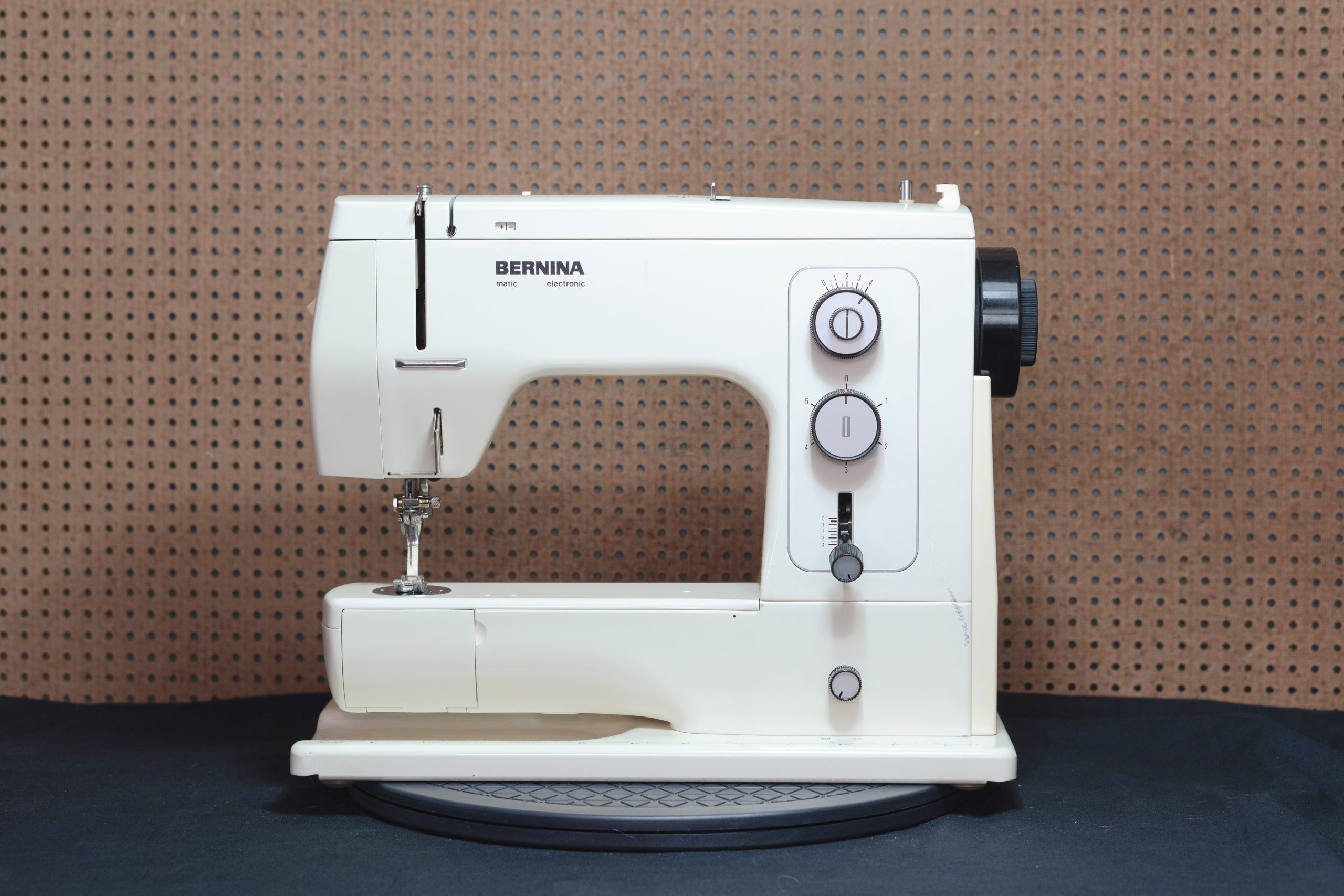
Bernina was founded in 1932 in Steckborn, Switzerland, by Karl Friedrich Gegauf, whose family had already been innovating in sewing technology since the 1890s (Gegauf invented the first automatic hemstitch machine in 1893). Through the 20th century, Bernina built its reputation on the CB (central bobbin) oscillating-hook system, prized for exceptionally clean, even stitch quality. A mechanical philosophy the company would carry, largely unchanged in principle, for decades.
Part of the “Matic Electronic” line, the Bernina 801 belongs to Bernina’s compact Minimatic series, produced mainly through the 1970s (with the later “801 Sport” variant made into the early 1980s as a lighter version with a built-in carrying handle). It is a 3/4-size machine, smaller and more portable than Bernina’s flagship Record series like the 730 and 830, yet built on closely related internals—sewists have noted it’s very similar to the Record 830, just with fewer decorative stitch patterns.
The 801 is a fully mechanical, cam-driven machine. The stitch cams are built-in and made of metal, there’s nothing to be lost or misplaced. While this gives the machine a fixed set of stitches, the lack of expansion also means that it will never lose any of its abilities. It features an all-mechanical build valued for durability, and an electronic foot control offering notably smooth speed regulation. The slim free arm allows fine cylindrical work like sleeves and cuffs. The metal one-piece bobbins with no holes, while specific to Bernina (recognisable by the stamped BB marking), are compatible with the ubiquitous Singer Class 15 bobbins. Unlike the top of the line Record 830, the 801 has no needle-up/down positioning and no knee-operated presser lift.
Even if this is a purely utilitarian design, certain Bernina standards are never lowered: a comprehensive set of utilitarian and decorative stitches, a simple drop feed mechanism, five step needle position, fine and direct stitch length and width controls, are staples of any Bernina machine of this era, as with most of its predecessors.
The 801 doesn’t break new ground so much as refine what Bernina had already perfected. Its true innovation is one of packaging: bringing CB oscillating-hook stitch quality, normally reserved for full-size flagship machines, into a smaller, lighter, more affordable body. The electronic foot pedal was itself a meaningful step up from purely mechanical pedal resistance, giving finer control over speed than earlier friction-based designs. The all-mechanical construction is widely regarded as extremely durable and reliable, with many 801s still fully functional after 40-plus years, needing little beyond basic servicing. Compared to Bernina’s own flagship Records, the 801 is seen as a smart budget alternative for anyone who won’t miss the extra decorative stitches. Compared to rivals like Pfaff, some sewists find Bernina’s older accessory feet less advanced than Pfaff’s integrated IDT (dual feed) system, though Bernina feet make up for it in perennial dependability.
Bernina’s lineage from this era was somewhat conservative technologically, relatively stagnant in design terms through the 1970s and into the 80s while competitors like Pfaff and Viking pushed ease-of-use innovations such as automatic thread trimming. But for the 801 specifically, that conservatism reads as a virtue: a simple, transparent mechanism that’s easy to service, resistant to obsolescence, and still delivers a stitch quality many consider a benchmark even against modern machines. There was a reason why Bernina stuck to the same formula for various generations: it was a formula of excellence and unmatched quality, uncompromising from the start. This proved more valuable than flashy and fragile innovations, as Bernina is today the only independently owned and operated sewing machine manufacturer.
Accessories include:
• Original foot control
• Accessory box
• Extension flatbed table
• Carrying case


ID
| Maker | |
| Brand | |
| Model | |
| Year | |
| Serial number | |
| Origin | |
| Manufacture | |
| Provenance | |
| Status |
SPECS
| Voltage | AC 220 V |
| Bed type | |
| Bed extension | |
| Feet/shank type | |
| Foot pressure adjustment | |
| Bobbin type | |
| Hook/race position | |
| Hook movement | |
| Bobbin winder | |
| Spool pins | |
| Bulb type | |
| Original foot control | |
| Current foot control | |
| Dimensions | |
| Weight |
FEATURES
| Zigzag | |
| Reverse type | |
| Needle position control | |
| Stitch length limiter | |
| Stitch width limiter | |
| Utility stitches | |
| Decorative stitches | |
| Stretch stitches | |
| Auto-reverse stitches | |
| Double needle provisions | |
| Drop feed |
ACCESSORIES
| Presser feet | |
| Straight stitch needle plate | |
| Feed dogs cover plate |
DOCUMENTS
| User manual | Download PDF: |
| Service manual | Download PDF: |