
Singer 338
Full metal jacket
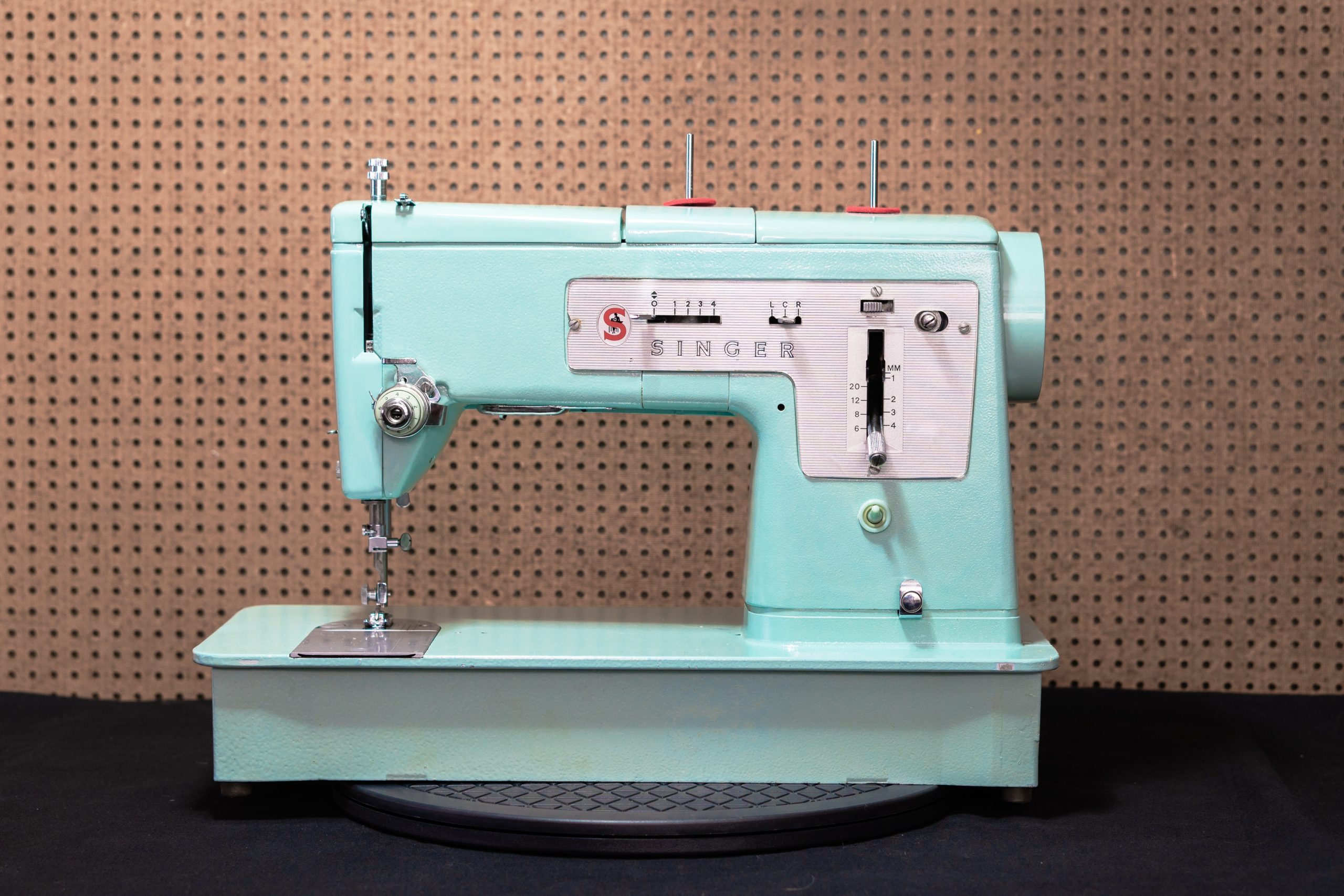
Singer has been the world’s most recognizable sewing machine brand since Isaac Singer patented his first practical machine in 1851. By the mid-20th century, the company had built an empire on mass-produced, affordable machines found in homes across the globe, constantly refining its designs to bring new stitching capabilities to everyday sewists.
The Singer 338, also marketed as the “Style-Mate,” rolled off the production line in 1965, sitting within Singer’s 300-series of mid-range, low-shank, zigzag machines. Rather than belonging to the later “Touch & Sew” line, the 338 is part of an earlier fashion-disc generation — a class 66 oscillating-hook machine with an all-metal drivetrain that predates Touch & Sew’s internal bobbin-winding system.
As seen here in its lovely typical robin’s egg blue paintwork, the 338’s signature feature is its use of interchangeable fashion discs, along with a drop-in bobbin positioned in front of the needle — a distinctive layout compared to many rivals of the era. These flat cams allowed the machine to produce zig-zag and roughly eight additional decorative stitch patterns without needing to swap out mechanisms to return to plain straight stitching. It also offers fine stitch-length control for satin stitching and a clamp-style throat plate for easy removal and cleaning. The stitch cams are the same type used on Singer’s contemporary “Swing Needle” machines, such as the 306 and 319, though on the 338 they’re tucked beneath a cam cover.
The only thing missing here is a drop feed function. This was not yet common in domestic sewing machines, which usually included some sort of cover to place over the needle plate, in order to raise the working surface above the feed dogs. This practice was kept even by many recent machines, for economy reasons, as a small metal cover plate was much cheaper than designing and producing a drop feed complication.
The 338 has a strong reputation among vintage sewing enthusiasts as a dependable, no-nonsense workhorse. A tank of a machine, not among Singer’s sleeker, sportier models, but a sturdy, reliable one that gets the job done with minimal fuss. Owners praise its all-metal gear train, which has allowed many surviving examples to still sew perfectly after 50-plus years with only basic servicing. One reviewer with a related model in the same family called it “indestructible” and noted it was one of the last fully metal-geared Singers before the brand shifted toward machines with more plastic components. And this model is, indeed, a 100% metal mechanism, including all cogs, pinions, gears, pulleys, and even the control knobs, levers and handles.
The only plastic found here (apart from the removable fashion discs) is the face plate, which is not just decorative, as it includes slits for the stitch controls and needle position. And the needle position control slit, in particular, is indispensable for the main adjustments when servicing the machine, making it of critical importance. This was an unfortunate choice and constitutes the model’s Achilles heel, as the machine becomes unserviceable without a faceplate.
Still, a recurring theme in owner reviews is ease of repair, since most mechanical issues can be diagnosed and fixed without requiring a technician. Compared to the later Touch & Sew range, which added conveniences like in-place bobbin rewinding but introduced more failure-prone rubber and gear components, the 338 and its 300-series siblings are generally seen as mechanically simpler and more forgiving to maintain long-term, even if they lack added convenience features. For sewists prioritizing durability and easy home repair over bells and whistles, the 338 remains a well-regarded, budget-friendly choice on the vintage market today.
Accessories include:
• Accessory box
• Presser feet assortment
• Straight stitch needle plate
• Darning plate cover
• Fashion discs


ID
| Maker | |
| Brand | |
| Model | |
| Year | |
| Serial number | |
| Origin | |
| Manufacture | |
| Provenance | |
| Status |
SPECS
| Voltage | AC 220 V |
| Bed type | |
| Bed extension | |
| Feet/shank type | |
| Foot pressure adjustment | |
| Bobbin type | |
| Hook/race position | |
| Hook movement | |
| Bobbin winder | |
| Spool pins | |
| Bulb type | |
| Original foot control | |
| Current foot control | |
| Dimensions | |
| Weight |
FEATURES
| Zigzag | |
| Reverse type | |
| Needle position control | |
| Stitch length limiter | |
| Stitch width limiter | |
| Utility stitches | |
| Decorative stitches | |
| Stretch stitches | |
| Auto-reverse stitches | |
| Double needle provisions | |
| Drop feed |
ACCESSORIES
| Presser feet | |
| Straight stitch needle plate | |
| Feed dogs cover plate |
DOCUMENTS
| User manual | Download PDF: |
| Service manual | Download PDF: |